Closing 2025 With Gratitude and Looking Ahead to 2026
As we close out 2025, this is a natural moment for reflection and for looking ahead with both honesty and resolve. This past year reaffirmed why Engineers Without Borders USA exists. We support communities as they build a better world through locally led, sustainable infrastructure, and we cultivate leaders who will carry that work forward for generations.
If I had to describe my feelings as the year draws to a close, it would probably match the mix of exhaustion and exhilaration a marathon runner feels as they cross the finish line knowing they crushed their own personal record. 2025 was hard. Dramatic policy shifts were heartbreaking, and many of the changes we experienced were outside our control. At the same time, I feel deeply proud. Proud of how our team and our community navigated this moment, honored our commitments, and refused to give up on the communities and volunteers who rely on us.
This reflection is grounded in three interconnected ideas. The power of partnership and community-led infrastructure. Building a better world through appropriate, ground-up innovation. And the people who make this work possible.
Partners, Communities, and the Power of Local Leadership
One moment from this year continues to stay with me. In February, we celebrated the opening of what is now the longest suspended pedestrian bridge in Uganda. Built in the Kasese region, the bridge connects two communities that for generations were separated by a river that could swell without warning, sometimes with deadly consequences.
This bridge is a feat of engineering. Designed to withstand a one-hundred-year flood, it is already delivering meaningful social and economic impact. Children can safely travel to school. Women can reach healthcare and markets without risking their lives. Businesses are emerging. A local school is growing. Safety, opportunity, and dignity now cross that river every day.
When we first began working in Uganda, the need was overwhelming. Communities across the country were reaching out for support. We faced a familiar dilemma. How do we say yes responsibly, and how do we do the most good with limited resources?
The answer came through partnership. Together with Peter Nzabanita and his team at Engineers Without Borders East Africa we made a deliberate decision to focus on one project and do it right. This bridge would serve as a demonstration of what is possible when infrastructure is placed in the right location and when local leadership is trusted and empowered.
The results have exceeded anything we could have predicted. The bridge is now celebrated nationally as a transformative investment. The Ugandan government has taken notice and is working with Peter and his team to explore additional bridge projects across the country. This is recognition of the catalytic role that well designed infrastructure can play in improving health, economic opportunity, and overall well being.
Equally transformative was how the bridge was built. Local tradespeople led the work. Women from the community were trained not only in construction, but in engineering, design, and decision making roles. Watching women in hard hats lead design discussions was one of the most powerful moments of the year for me. It activated leadership, confidence, and entrepreneurship that will last far beyond this single project.
This experience reinforced a simple but profound truth. We can do so much with so little when we let our partners lead.
We are seeing this same momentum across our network. In Peru, our country coordinator, Giovana, is building strong, strategic partnerships that are laying the groundwork for similarly catalytic projects. In Ecuador, our partners at FIEA Ecuador are strengthening healthcare systems by improving water, sanitation, and electrification infrastructure. We are nearing completion of a critical healthcare facility in Alausí, and I look forward to opening it in 2026 and witnessing the ripple effects that strong partnerships make possible.
Building a Better World Through Ground-Up Innovation
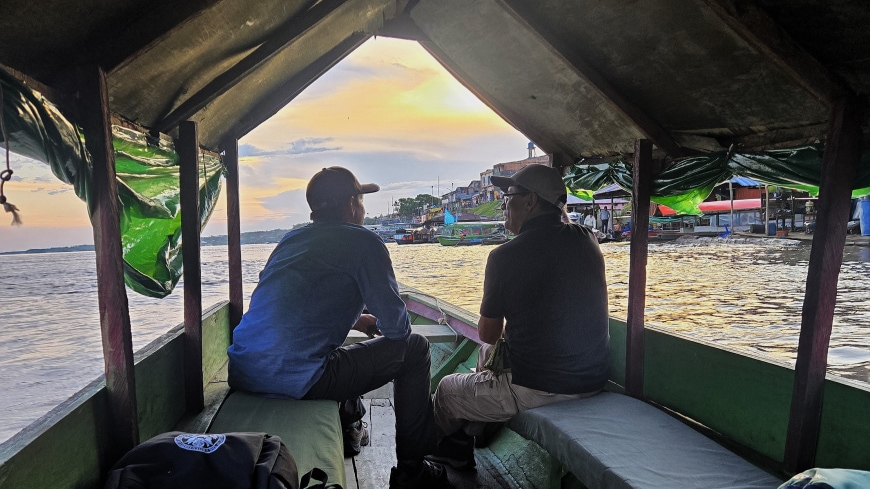
Another defining experience this year came during a visit to the Peruvian Amazon. Flying into Iquitos, seeing the Amazon River from above, and then traveling by boat to remote communities was humbling beyond words.
These are communities working tirelessly to secure something many of us take for granted. Safe water and basic sanitation for their children. Rates of waterborne illness are staggering. At the same time, these communities face constant environmental instability. The Amazon River shifts relentlessly, eroding banks, flooding land, and forcing families to relocate again and again.
In these conditions, conventional infrastructure solutions simply do not work. What does work is appropriate, community designed innovation.
I was deeply struck by rainwater harvesting systems that double as schools or community centers. Large roofs serve multiple purposes, providing clean water while anchoring communal life. These systems are trusted, maintained locally, and designed for reality as it exists on the ground.
This experience reminded me that the best ideas do not come from afar. They come from communities themselves, working in partnership with engineers who listen. Our responsibility is to help refine, support, and scale what communities already know will work for them.
This year also brought major shifts in community development funding. In March, we learned that we would not receive expected federal funding for our domestic work. At first, we set an aggressive agenda to replace that funding. By early summer, it became clear that this would not be possible quickly enough. Like many organizations, we were operating in an environment where demand for philanthropic support far exceeded what private donors could provide.
This led to some of the most difficult decisions we faced all year, including staff reductions and program pauses. Leading through this period required a careful balance. We had to look at reality honestly while still cultivating hope. Hope is not delusion. Hope is something we actively work toward. It is an action.
In the midst of this uncertainty, something profoundly hopeful happened. Families, foundations, and individual donors stepped forward to ensure continuity. A generous family fund, set up in honor of a late EWB-USA volunteer, stands out as a powerful example. Their generosity accelerated our work in Peru and allowed us to continue supporting communities despite policy changes. Commitments from partners like Xylem backing our work in Kenya is another example, further affirmed that momentum is building behind our partner driven approach.
This is what it looks like when communities support communities, and when leaders support leaders across borders and distances.
The People Who Make This Work Possible
Engineers Without Borders USA is powered by people. Our volunteers bring their expertise to some of the most complex design challenges imaginable. They show up with humility, care, and commitment. They lead community partnerships, and this year they redoubled their efforts.
Despite the disruptions of 2025, we completed 83 projects across 15 countries. This is the third highest total in our history and the highest since 2016, i.e. post pandemic. These projects, along with all of the projects in progress and those that begun in 2025 will reach more than 848,000 people, with several large-scale water and infrastructure initiatives driving that impact.
These projects have impact, we finalized and cut the ribbons on 27 domestic projects in the United States, reaching over 35,000 people. Our international community programs fully rebounded from the COVID downturn, completing 49 projects and serving more than 67,000 beneficiaries.
In total, 555 projects were active or in development at some point during the year, with 96 new projects launched. These numbers matter because they reflect something deeper. Even in a year of constraint, we did not step away from our mission.
Our staff made this possible by prioritizing high-value actions and by adapting quickly. Teams took on expanded roles. Fundraising efforts accelerated and overperformed in nearly every channel outside of federal funding. Operational, finance, and systems teams kept us grounded in reality while enabling the most important work to continue. It is hard to single out any one group because resilience showed up everywhere.
As the engineering profession continues to evolve, especially with rapid advances in artificial intelligence, many technical functions will change. What will not be replaced are the human elements of this work. Relationships. Trust. Courage. Partnership. Compassion.
Engineers Without Borders USA exists to build a world worth leaving to our grandchildren by building the next generation of engineers who see the entire world as the place where they can make their impact. Challenges may slow us down, but they do not change our course.
Looking Ahead With Gratitude
We feel most alive when we give. Our volunteers feel it when they give their time and talent. Our donors feel it when they give their resources. I feel it every day I have the privilege of serving this organization.
As we move into the year ahead, I am hopeful in a grounded way. The lessons of this year have strengthened our focus, clarified our partnerships, and reaffirmed our values. We are becoming a more resilient organization because we chose to face reality honestly and to act with intention.
To every donor, volunteer, partner, and community member who walked alongside us this year, thank you. Thank you for believing in the power of infrastructure, in local leadership, and in a world where everyone has the opportunity to thrive.
I am deeply grateful to walk this path with you, and I am excited for what we will build together in 2026.