Bad Bunny's Halftime Set Reveals the Dark Side of Puerto Rico's Energy Grid
.png?resize=870x0&crop=870x489)
This past Sunday, millions of people watched Bad Bunny take the Super Bowl halftime show and turn it into a ‘love letter’ to Puerto Rican culture. The 13-minute-long Spanish performance was rooted in Puerto Rican culture and rich with symbolism so clear that it didn’t require translation. One of the most striking visuals was the power-line portion of his stage, with dancers moving across poles and wires that felt instantly recognizable to anyone who has lived through repeated energy blackouts.
More than just a passing image, this moment served as an important spotlight.
In that moment, a global audience saw an artistic rendering of what many Puerto Ricans experience regularly. Access to reliable electricity is about more than just convenience and comfort. When power cuts out, life and businesses are interrupted, communication gets cut off, and health systems falter. Life does not pause while waiting for the power to return.
Bad Bunny did not need to narrate that reality to us; the imagery spoke clearly from the center of the field.
As the week goes on and the headlines reliving the performance start to dwindle down, the question remains: what do we do with the awareness that the performance created?
Understanding the issue: A grid under strain, long before the spotlight
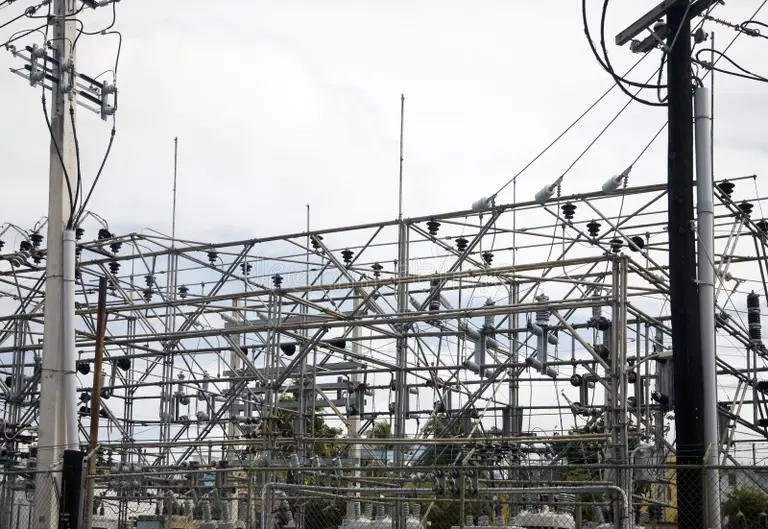
Despite recent attention, Puerto Rico’s energy challenges are not new, and the truth is that the issue runs much deeper than many realize.
In its’ 2019 Puerto Rico Infrastructure Report Card the American Society of Civil Engineers gave the island’s energy system a grade of F, citing poor existing conditions, insufficient redundancy, inadequate restoration planning after the 2017 hurricanes, and the need for system-wide improvements.
The report card describes a system vulnerable not only to major storms but also to routine stress. A lack of maintenance and a failure to build to the appropriate standards can contribute to system-wide collapses during heavy wind events. So while Puerto Rico has captured national attention for it’s wide-spread power outages several times in the past decade following hurricanes and tropical storms, the grid is extremely fragile even in less dramatic weather.
At the time of ASCE’s report, Puerto Rico’s electricity generation was still overwhelmingly fossil fuel-based (roughly 98%) and residents were paying electricity rates significantly higher than the national average.
Infrastructure on this scale does not fail overnight, and it can not improve overnight either. ASCE outlined practical steps toward resilience that would look familiar in any state or territory: build to strong wind standards, increase redundancy, adopt smart grid technologies, diversify energy sources such as solar and wind, and establish transparent, auditable investment timelines.
These engineering fundamentals are about reliability, safety, and long-term planning. While island-wide modernization will take time and significant investment, distributed resilience projects can help protect communities right now. That’s where Engineers Without Borders USA’s Domestic Program comes in.
Building resilience that is local and tangible
At Engineers Without Borders USA, our domestic program (known as Community Engineering Corps) has been supporting communities in in the US and its Territories, including Puerto Rico, for over a decade by partnering with communities to design practical infrastructure solutions. In Puerto Rico, that work often centers around a critical question: “How do we keep critical community services running when the grid cannot?”
The answer often lies in working with communities to design upgrades to key shared spaces, like schools, community centers, or healthcare facilities, so that they can become resiliency centers when the lights go out and other essential services are interrupted.
When blackouts impact community health
The mountains of Jayuya
In the mountainous municipality of Jayuya, residents experience limited access to healthcare and often have to travel long distances (just under two hours to San Juan) to receive critical treatments. Our partners at the Ven-Rose Foundation opened their doors in 2017 with the mission of providing integrated care and life-saving services like chemotherapy, and dialysis to low-income patients in the Municipality of Jayuya and its bordering towns.
Here, the stakes are high and energy reliability directly affects whether that care can continue effectively. The challenges of recurring blackouts are felt especially acutely in Jayuya, where over 60% of residents live below the poverty line, and the median household income hovers around $18,500 annually. They feel the high strain of expensive electricity, and are impacted deeply by its unreliability.
To build resilience and help ensure access to quality healthcare for residents of this region, the community is partnering with volunteers from Engineers Without Borders USA’s University of Wisconsin-Madison Chapter who are supporting the design of a photovoltaic solar system with battery storage for the Ven-Rose facility. The system is intended to mitigate intermittent outages during normal times and provide backup during extended outages caused by natural disasters. The volunteer’s design team is working closely with local firm, AZ Engineering, who will make the designs come to life through local contractors working with the firm.
In this setting, solar panels and batteries are so much more than technical components in the push forward for clean energy. They are an affordable, sustainable, and life-saving solution to a chronic infrastructure failing.
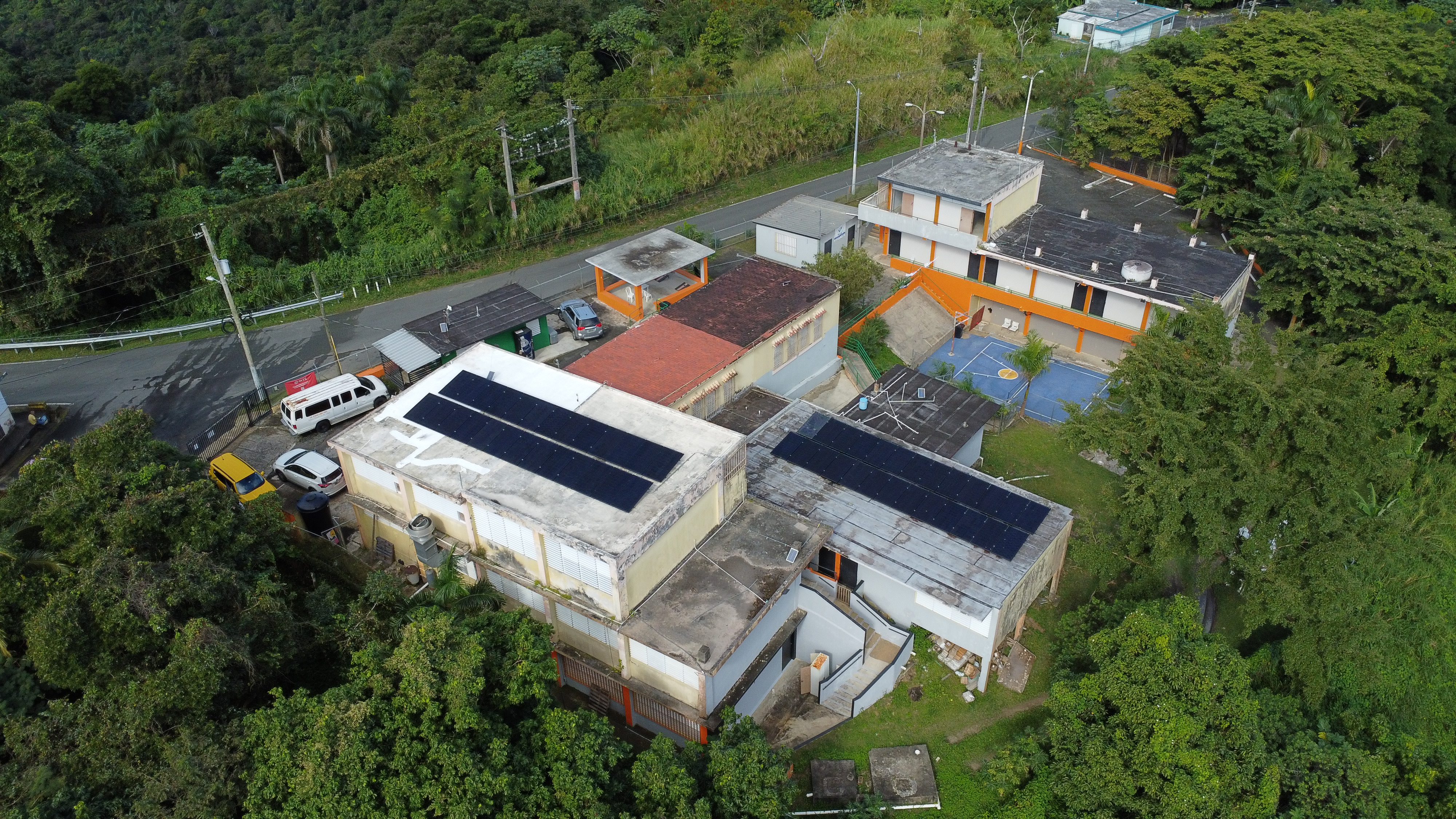
Photo Credit: Nathan Woolf , University of Wisconsin Madison Puerto Rico, Solar, Canóvanas, Puerto Rico
The island of Vieques
On the island municipality of Vieques, located just off the coast of the South East of Puerto Rico’s main island, resilience takes a different but equally urgent form. The Vieques Conservation and Historical Trust operates a resilience hub that supports the community during emergencies. A central need that they have is refrigeration for medications and special nutrition, particularly for older residents and individuals with health conditions.
Here, EWB-USA’s Greater Austin Professional Chapter, alongside the Puerto Rico Professional Chapter, is assisting with the design feasibility assessment for expanding the facility’s existing solar capacity. The goal is to ensure that when primary systems go down, the hub can still provide refrigeration, basic power, and communication capacity for the surrounding community.
In moments of crisis, something as simple as keeping insulin cold, thanks to expanded solar capacity, becomes a form of life-saving infrastructure.
The hills of Las Marias are gaining water and energy stability
In Las Marias, resilience is being approached through several projects in the region, focused on creating long-term stability for residents.
One project, in partnership with Volunteers of America National Service, is working with a housing community, home to 40 multi-family units (all occupied by families run by low-income single mothers), who experience regular disruptions to water access, especially during storms or power outages. The infrastructure, now decades old, is no longer reliable.
An EWB-USA team made up of volunteers from our partner GEI Consultants is working to support the efforts to design a potable water cistern system for this building, which is owned by Volunteers of America Networks (VOANs). The system will store a minimum of three-day reserve of clean water for use during outages, and will meet drinking water standards to protect public health.
For the families who live here, many of whom fall well below the area median income, the cistern represents more than convenience. It’s stability during crisis. It’s peace of mind. It’s a tangible improvement in daily life. Once implemented, the system will be maintained by VOANS, helping to ensure that clean, accessible water is available for current and future residents.
Building Systems that Last
Bad Bunny’s power-line imagery on the Super Bowl stage resonated because it reflected lived experience. The engineering work that follows, though less visible, is the key to solving this chronic issue.
The ASCE’s report makes it clear that long-term resilience requires strong design standards, hardened systems, redundancy, diversified energy sources, and transparent investment planning. These are critical, systematic moves that require commitment, coordination, resources, and sustained attention.
When conversations about infrastructure become too abstract, it can be easy to forget stories like those above, of those who experience the consequences most directly. But that is why it is important that we work toward community-based resilience solutions, helping Puerto Rican residents address immediate needs while the long-term solutions catch up. While these solutions are not a substitute for systemic improvement, they are an important and life-saving complement. Distributed solar, battery storage, and resilience hubs can reduce risk and protect lives while larger grid reforms take place.
What comes after the spotlight
The super bowl half-time show is one of the world’s largest stages, and it was used to shine a light on a reality that deserves attention. The performance crossed language barriers and invited a broad audience to see Puerto Rico’s grid challenges with empathy.
We can honor that moment by choosing to not let it fade into the background.
Here are some ways that you can turn awareness into action:
- Stay engaged beyond the headlines: Learn what grid resilience actually requires. Follow credible infrastructure reporting. Pay attention to standards, maintenance, redundancy, and long-term investment plans. Reliable systems are built through sustained public attention.
- Support community-driven resilience. Engineers Without Borders USA’s Domestic Program works alongside local partners to design practical energy and water solutions. Financial support helps move projects from design to implementation, ensuring clinics, shelters, and community hubs can continue serving people when the grid fails.
- Volunteer your expertise. Engineers, energy professionals, project managers, and corporate partners can play a direct role in strengthening community infrastructure. Technical knowledge, mentorship, and partnership accelerate solutions and expand what is possible.
The halftime show gave us an image we will remember. What we build next determines whether that image represents struggle alone or resilience backed by action.
Puerto Rico’s communities are already doing the work. The rest of us can choose to stand with them.