Celebrating The Many Leaders Of EWB-USA
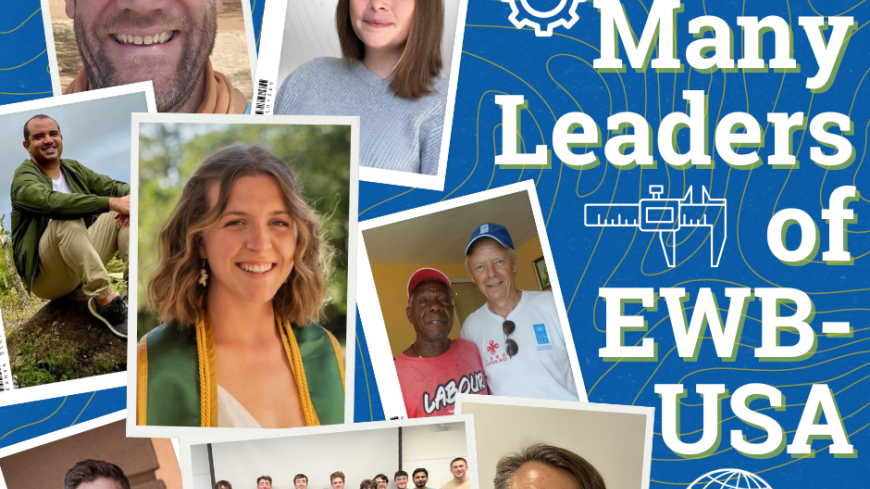
Leadership at Engineers Without Borders-USA doesn’t look just one way. It also isn’t defined by titles, credentials, or where someone is in their career. It shows up in students leading their first community meeting, in professionals mentoring new volunteers, and in the quiet consistency of those who listen before they build.
This year, we had the privilege of sharing stories from across the EWB-USA network that remind us that leadership is a collective effort. Together, they reveal a simple truth: when people step up with empathy and curiosity, communities thrive.
Growing Into Leadership
Leadership often begins quietly, be it through a single project meeting, a mentor's encouragement, or the realization that engineering can be deeply human.
For Katie Byrnes, leadership began long before she became a process mechanical engineer. As a student at Miami University of Ohio, she joined EWB-USA, unsure of her path. But through designing water systems, leading team meetings, and collaborating with global partners, Katie discovered not only her career direction but her capacity to lift others up. Today, she credits EWB-USA with giving her the confidence to pursue technical roles that align with her values, and she continues to mentor students who are just beginning their journeys. Learn more about her volunteer journey.
Luke Thompson found his voice through service. Starting as a student volunteer, he embraced partnership-based engineering: listening first, collaborating deeply, and grounding each decision in community priorities. His commitment carried him into leadership roles across the organization, ultimately becoming a Board Member. Luke’s path reflects how EWB-USA shapes leaders who are guided by humility, responsibility, and a global mindset. Read about his growth.
For Geneva Newell, leadership was about building belonging. As a chapter leader and Student Representative on the Board of Directors, she ensured that project teams reflected a wide range of experiences and perspectives. Her approach of asking whose voices are missing and how to make space for them strengthened not only her chapter’s culture but the quality of their engineering solutions. Geneva reminds us that leadership thrives when everyone is invited to participate. Find out more about what her role means to her.
And then there are leaders whose journey stretches across decades. Walt Walker began as a student volunteer at Rowan University, learning early that engineering grounded in community partnership asks as much of the heart as it does of the head. Over the past years, his roles grew from mentor, to committee leader, to technical advisor; shaping his philosophy of what engineering should be. Today, as Vice President, Equity Practice Leader at TYLin, Walt carries forward the lessons he learned with EWB-USA: that equitable engineering demands deep listening, shared power, and long-term commitment. Walt’s story shows the full arc of what EWB-USA makes possible. Uncover his leadership journey.
Leadership Through Learning & Support
Leadership doesn’t flourish in isolation. It grows through support systems, mentors, and collaborative learning.
At the University of Rhode Island, students experienced this firsthand. When they founded the URI EWB-USA chapter, they were building more than a student organization; they were creating a space where young engineers could learn to lead through community engagement. Their partnership with a Maryland community on a drinking water system taught them how to conduct assessments, manage meetings, and work respectfully with local stakeholders. Supported by faculty and professional mentors, these students demonstrated how leadership develops through practice, teamwork, and trust. Explore what chapters are capable of.
Much of that development is made possible by mentors, people like Nick Tooker, a faculty advisor at the University of Massachusetts, Amherst whose guidance has shaped countless student volunteers. Nick’s work spans technical review, leadership coaching, and global collaboration: from supporting students in Amherst to engaging with water partners in Nairobi during his upcoming Fulbright Fellowship. His leadership model emphasizes curiosity, humility, and staying grounded in community needs. Students often describe him as the mentor who helped them understand not just how to engineer solutions, but why those solutions must center the people who will use them. Discover more about his growth as a mentor.
Leadership Rooted in Local Expertise
EWB-USA’s work only succeeds when leadership is shared with local partners: the people who understand community needs, cultural dynamics, and long-term sustainability better than anyone.
In Nicaragua, Edrulfo Rodríguez and the EWB-USA country office embody this truth. Their team works year-round to support community partnerships, facilitate meetings, troubleshoot system issues, and build local technical capacity. Under Edrulfo’s leadership, projects gain continuity, cultural understanding, and the kind of long-term stewardship that makes community-driven engineering possible. His work reminds us that some of the most enduring leadership comes from those closest to the challenges and opportunities on the ground. And, as our decade-long partnership in Nicaragua concludes at the end of this year, we know that the knowledge, relationships, and systems strengthened through this collaboration will continue to serve communities for decades to come. Learn more about their work and our partnership with them.
And while some local leaders work directly with communities, others lead by strengthening the work long before a project ever reaches the field. Volunteers like Chris Zawalski and Gary Feuerstein play this critical, often unseen role. Chris brings years of experience in community-centered and accessibility-focused design, helping chapters balance feasibility with the realities of the people they serve. Gary draws on a global background in resilient infrastructure and disaster recovery, offering guidance that helps teams anticipate challenges and design with long-term durability in mind. Together, their reviews, safety support, and quiet mentorship ensure that communities receive thoughtful, rigorous solutions that volunteers are equipped to deliver confidently and responsibly. See what supporting chapters means to them.
A Stronger World, Built Together
From first-year students discovering their calling, to faculty shaping future leaders, to local experts sustaining long-term partnerships, one message is clear: leadership at EWB-USA is shared. It grows when students take initiative, when mentors listen, when communities build their own capacity, and when volunteers behind the scenes strengthen every detail.
The leaders we had the privilege of highlighting this year represent just a small fraction of the impact happening across our network. They are making waves in their fields, their communities, and throughout EWB-USA, but they are far from the only ones. Behind them stand thousands of volunteers, each with their own story, their own pathway into service, and their own way of making a difference. Some lead in classrooms, others in boardrooms, construction sites, or community meetings, but all are united by a shared passion for engineering that uplifts people.
To everyone who led, supported, and inspired this year: thank you.
Your leadership makes EWB-USA what it is today and what it will become tomorrow.